Blog
CELPIP speaking practice with AI: build confidence for timed prompts
A practical guide to CELPIP speaking practice: what to train, how to use AI between official mocks, and when official CELPIP materials or a tutor still matter.
CELPIP speaking practice is not only about memorizing templates. It is about staying clear, calm, and structured when a timed prompt appears and you need to answer out loud.
That is where AI can help. It gives you more speaking repetitions between official practice tests, tutors, and study sessions. It does not replace the official CELPIP format, scoring, or expert exam strategy, but it can help you build the fluency and confidence that many test takers are missing.
What to practice for CELPIP speaking
If you are preparing for CELPIP - General, speaking is part of the full test. If you are preparing for CELPIP - General LS, speaking is still part of the exam, but the overall test is shorter. Always confirm the exact version and current format you need on the official CELPIP website.
For day-to-day practice, focus on four things:
- answering quickly without freezing;
- organizing short answers clearly;
- speaking in natural everyday English;
- staying steady under time pressure.
That last point matters. CELPIP speaking is not only about language knowledge. It is also about response control when the clock is moving.
Why CELPIP speaking practice often breaks down
Many learners do enough reading and listening, but not enough real speaking.
Common problems:
- no regular speaking partner;
- too much passive study and too little output;
- over-reliance on templates that sound unnatural under pressure;
- panic when the answer has to start immediately.
This is why some learners feel fine while studying, then freeze during timed prompts.
Where AI speaking practice helps
AI is strongest as a practice layer between official prep materials.
It helps you:
- repeat speaking prompts as often as you want;
- practice solo without scheduling a partner;
- get fast feedback on grammar, clarity, and phrasing;
- redo the same answer after correction;
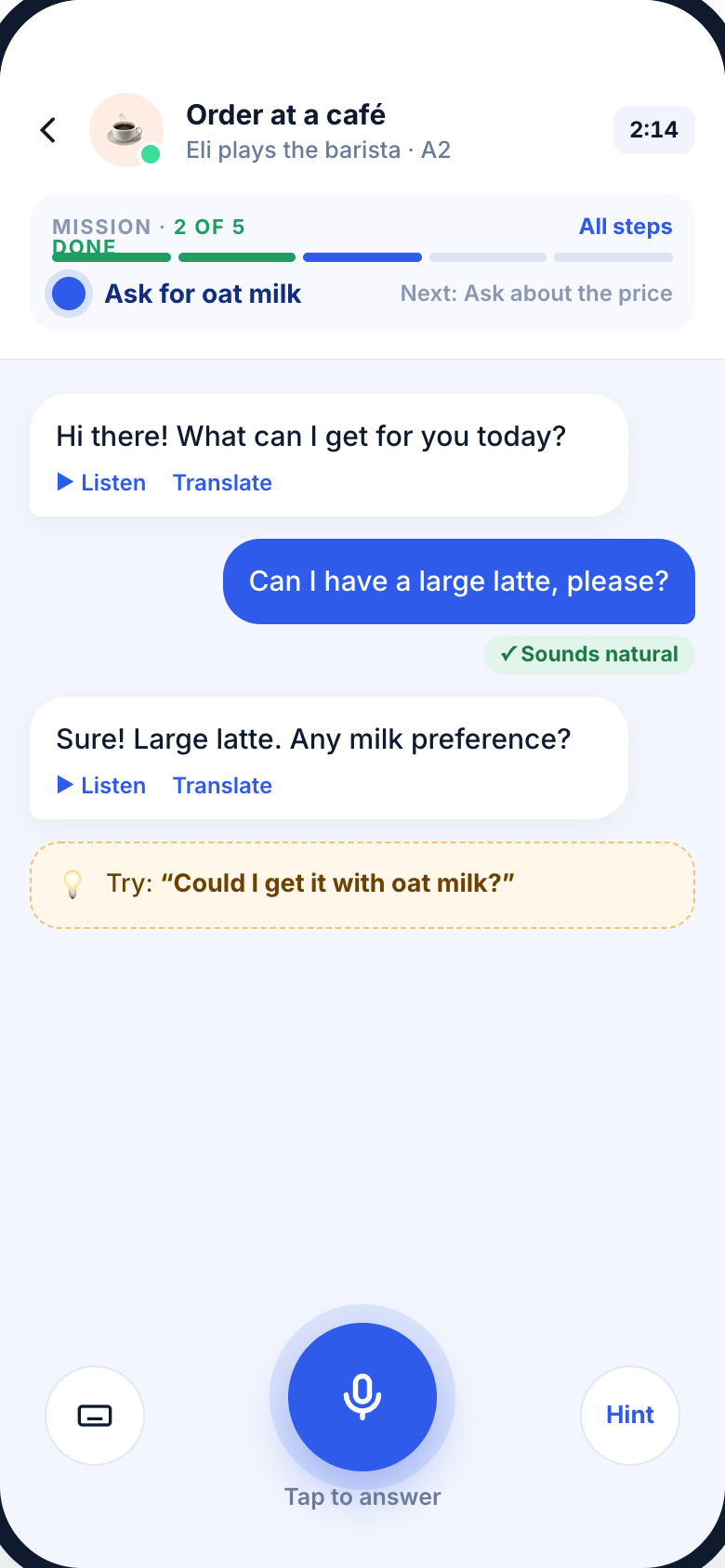
- build confidence with everyday scenarios that sound closer to real conversation.
That fit is useful for CELPIP because the exam is built around practical communication, not academic essay language.
The right mindset is simple:
- use official CELPIP materials for format accuracy and current exam guidance;
- use a tutor or experienced coach for rubric-specific strategy;
- use AI for daily speaking volume, repetition, and low-pressure correction.
A simple 15-minute CELPIP speaking routine
Here is a practical routine you can use between official mock tests.
1. Warm up for 2 minutes
Start with easy sentences about your day, work, or plans. The goal is not accuracy yet. The goal is to get your voice moving and reduce hesitation.
2. Do one timed prompt for 5 minutes
Pick one realistic prompt and answer it in a limited time.
Good practice types include:
- giving advice;
- describing a situation;
- explaining a choice;
- responding to a problem;
- sharing an opinion with one clear reason and one example.
Do not restart every time you hesitate. Finish the answer first.
3. Review and repeat for 5 minutes
Look at the weak points:
- long pauses,
- filler words,
- grammar slips,
- unclear structure,
- awkward phrasing.
Then answer the same prompt again with a cleaner version. This second round is where progress happens.
4. Save 3 upgrade phrases for 3 minutes
Write down three phrases you want to reuse, for example:
- “The main reason is…”
- “In this situation, I would…”
- “A simple example would be…”
- “From my point of view…”
- “What matters most is…”
Reuse those phrases in your next session until they become automatic.
What to do when you freeze
If you freeze under pressure, do not chase perfect grammar. Use a simple answer frame:
- give your main point;
- add one reason;
- add one example;
- close clearly.
Example:
Main point: “I would choose the second option.” Reason: “It is more practical and less stressful.” Example: “For example, if I had limited time, I could finish it faster and avoid mistakes.” Close: “So overall, that would be my choice.”
A simple structure beats a fancy answer that collapses halfway through.
When official CELPIP prep or a tutor is the better choice
AI practice is helpful, but it has limits.
Choose official CELPIP materials when you need:
- the current task format;
- official timing details;
- up-to-date test information;
- formal familiarity with the exam flow.
Choose a tutor or CELPIP-focused coach when you need:
- feedback tied closely to the exam rubric;
- help with weak answer structure;
- strategy for recurring speaking problems;
- targeted work before a retake.
Choose AI speaking practice when you need:
- more repetitions;
- flexible daily practice;
- immediate correction;
- a lower-pressure space to build speaking confidence.
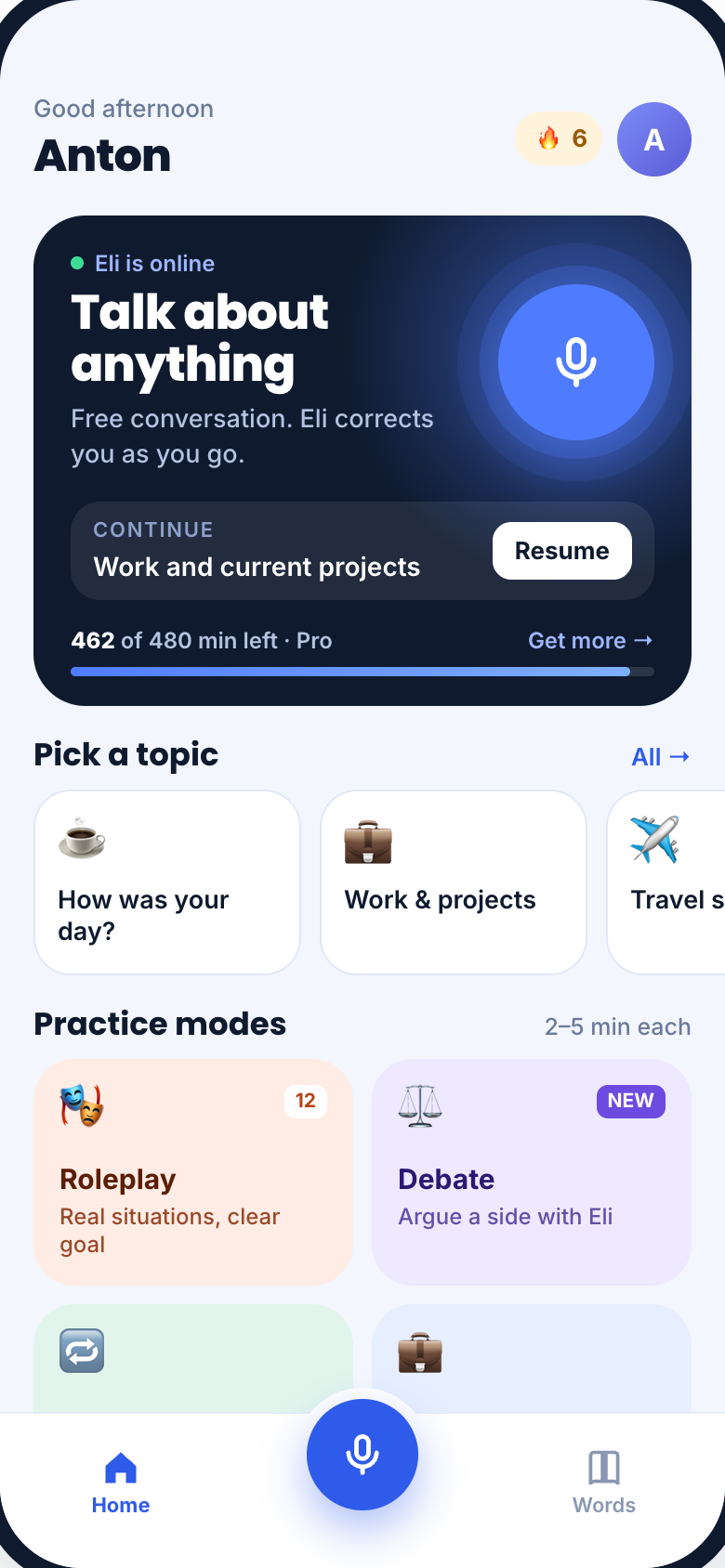
That is the honest role for Elispeak. It is a practice tool, not an official CELPIP product, scorer, or immigration advisor.
FAQ
Can AI replace a CELPIP tutor?
Not fully. AI is great for daily speaking practice and fast repetition. A tutor is still better when you need exam-specific strategy or detailed rubric-based feedback.
Is AI useful if I already do official CELPIP mock tests?
Yes. Official mocks show where you are. AI helps you train more often between those mocks so you arrive with better speaking speed and confidence.
What if my biggest problem is freezing?
Use shorter answers, a fixed structure, and repeated timed prompts. Confidence usually grows when response speed improves, not when you try to sound perfect.
Keep practicing between mock tests
If you want more daily speaking support, these guides can help next:
- AI English tutor for speaking practice
- Speak with AI in English
- How to improve English speaking confidence
- Free English speaking level check
Ready to practice timed speaking with instant feedback? Start practice in Elispeak.