Marketing
Eli vs ChatGPT: specialized AI English tutor vs chatbot
ChatGPT is a general LLM. Eli is a specialized AI English tutor with structured scenarios, pronunciation feedback, and an ESL progress path.
Short answer: ChatGPT and Eli (by Elispeak) can both help you practice English, but they sit at different layers. ChatGPT is a general-purpose large language model that you prompt for English help; what you get depends on your prompt skill. Eli is a specialized AI English tutor product with pre-built scenarios, voice in and voice out, in-turn corrections, pronunciation-aware feedback, and a progress path for ESL learners. ChatGPT is the engine; Eli is the finished English-tutor product. Pick ChatGPT if you prompt-engineer well and want free-form practice; pick Eli if you want the structured ESL experience by default.
Last updated: 2026-05-13.
Quick verdict
- Choose ChatGPT if you already prompt-engineer well and just need free or low-cost open-ended language practice.
- Choose Eli if you want structured scenarios, immediate pronunciation and grammar feedback, and a clear progress path for ESL learners by default.
- Many learners use both: ChatGPT for grammar lookups and writing, Eli for structured speaking reps.
Product positioning
ChatGPT
ChatGPT is positioned as a general-purpose AI assistant:
- general LLM that handles any language task you prompt for;
- voice mode for spoken back-and-forth;
- no built-in scenario library, retry loop, or progress tracking for English learners;
- output quality depends on how well you prompt it.
This is great for learners who can write a tight prompt (“act as a job interview coach for a senior product manager role in fintech, ask me 5 behavioral questions, correct my answers in-turn, focus on filler words and answer structure”) and want unlimited open-ended sessions.
Eli (Elispeak)
Eli is positioned as a specialized AI English tutor for ESL learners:
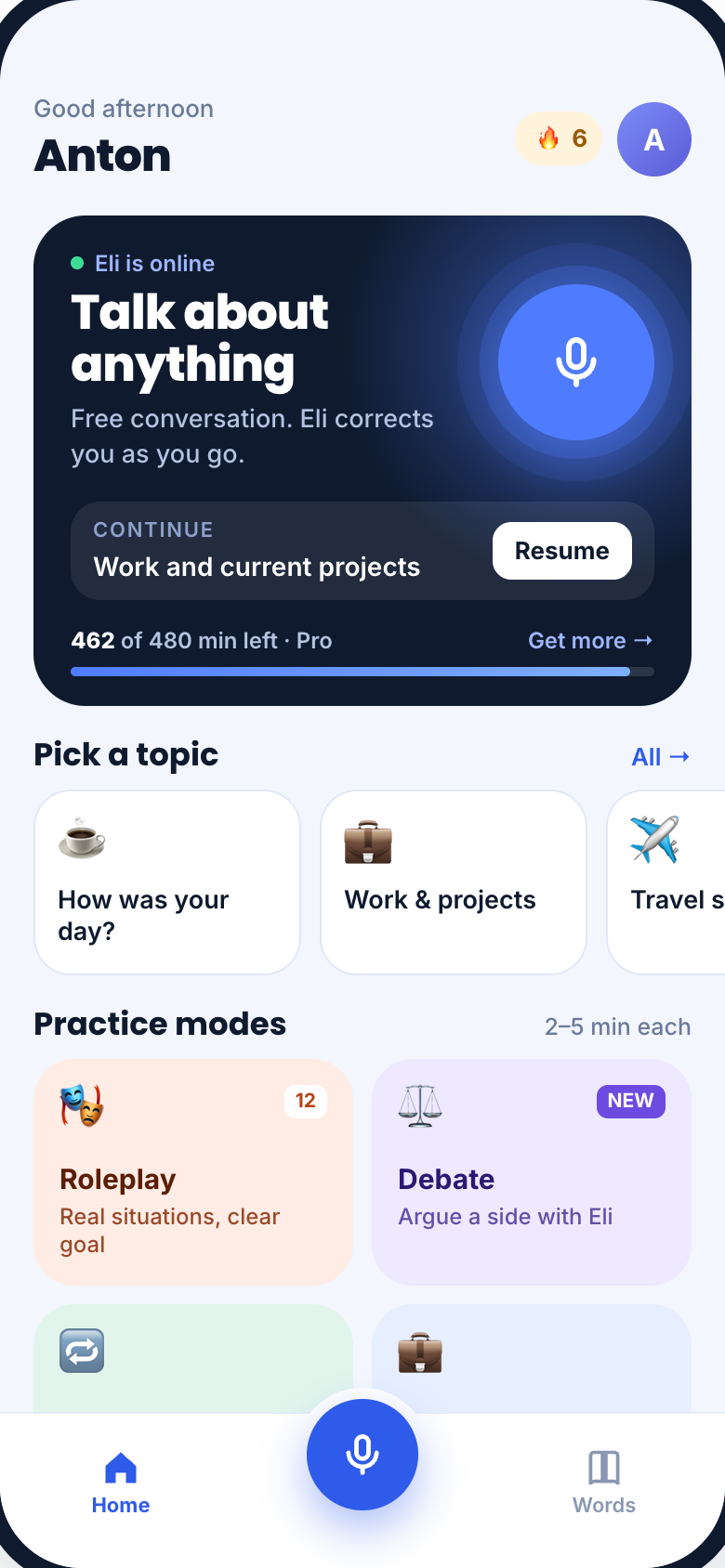
- scenario-based sessions with a clear objective (interview, work meeting, status update, customer call, small talk, travel);
- pronunciation-aware feedback inside complete answers, by default;
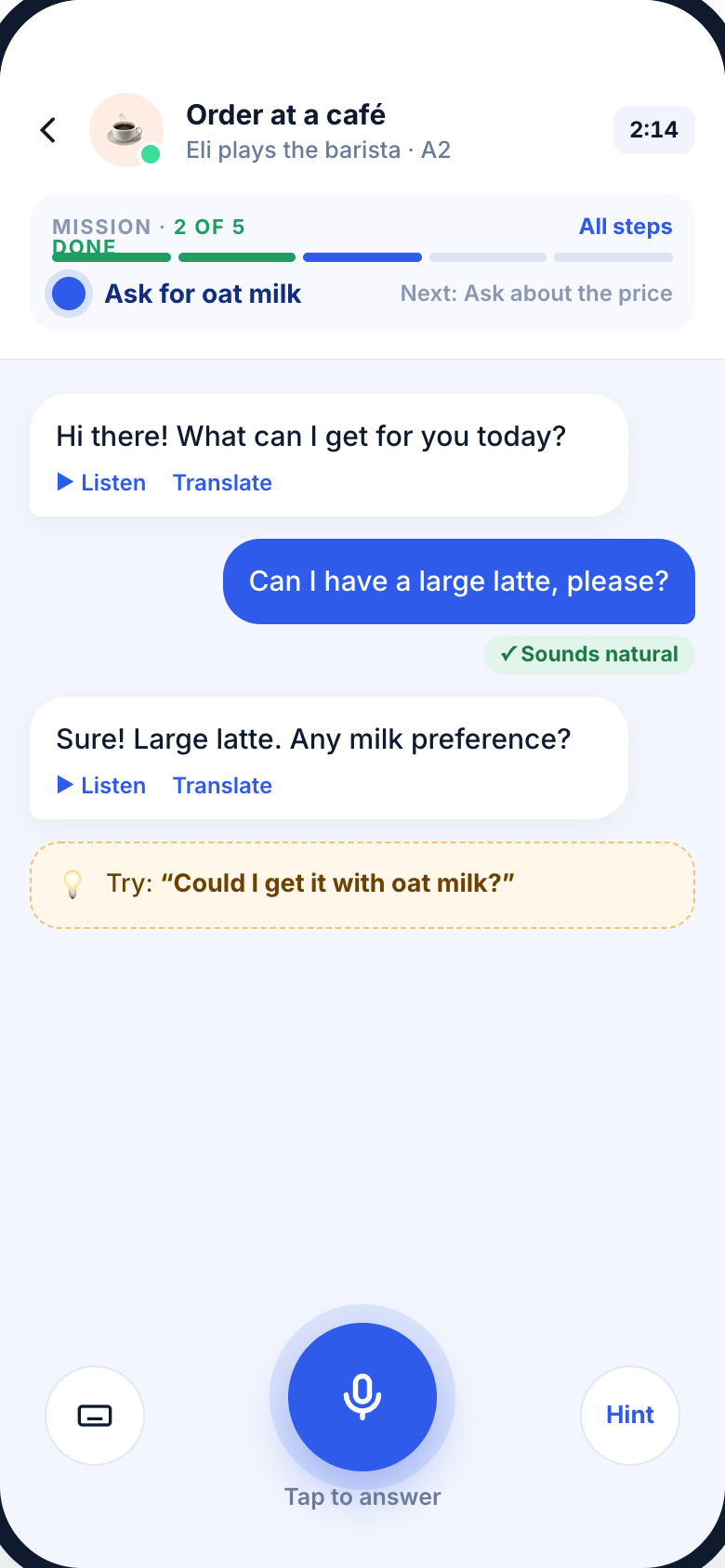
- in-turn grammar and clarity corrections;
- a repeat-and-improve loop inside the same session (re-answer the same prompt with the suggested fix);
- short daily sessions (10 to 20 minutes) and a free 15-minute daily tier;
- progress and history across sessions, not just per-chat.
This is built for the learner who wants the English-tutor experience without prompt-engineering it from scratch every session.
Side-by-side comparison: Eli vs ChatGPT
| Feature | ChatGPT | Eli (Elispeak) |
|---|---|---|
| Product shape | General LLM | Specialized AI English tutor |
| ESL-shaped scenarios | Prompt for them yourself | Pre-built library |
| Voice in and voice out | Yes (voice mode) | Yes, by default |
| Pronunciation feedback | Prompt for it every turn | Built into the speaking loop |
| Retry loop on the same prompt | Manual | Built in (re-answer same prompt) |
| Correction style | LLM commentary | ESL-shaped in-turn corrections |
| Progress tracking | None for English specifically | Yes, across sessions |
| Free tier | Free general use, voice has limits | 15 minutes per day, free |
| Entry price | $20 per month (Plus, general LLM) | 1.99 EUR for a 7-day full-access trial |
| Most popular plan for daily practice | Plus subscription | 9.99 EUR per month, 480 min |
| Best for | Open-ended language and writing help | Structured ESL speaking reps |
Current Eli pricing is on the Elispeak pricing page.
Where ChatGPT can feel limited
ChatGPT users who try to use it as their daily English tutor often hit these limits:
- you have to rebuild the prompt every session, which kills daily habit;
- the default voice mode chats, but does not run a “scenario + retry” loop unless you orchestrate it;
- pronunciation feedback is general LLM commentary, not a specialized speech model;
- no progress signal across days (each chat is independent);
- no scenario library built around the situations ESL learners actually face.
Where Eli has an edge
Eli is stronger when the bottleneck is “I want to practice today, not design a tutor today”:
- open the app, pick a scenario, speak, get correction, retry, done in 10 minutes;
- pronunciation-aware feedback inside complete answers, no extra prompting required;
- ESL-shaped scenarios (job interview, work meeting, customer call, small talk, travel);
- session history and progress signal across days, so daily reps compound;
- a lower-friction path to actually doing the practice, which is what determines outcomes long term.
How to evaluate both in one week
- Day 1-3: pick one upcoming real conversation (interview, presentation, work meeting). Try to practice it daily in ChatGPT voice mode using a prompt you wrote yourself. Track how many full reps you actually finish.
- Day 4-7: practice the same conversation in Eli using the matching scenario. Re-answer the same prompt with each correction. Track full reps.
- Compare: which side did you actually use 4 days in a row, and which day-7 first-answer sounded cleaner?
For most ESL learners, the lower-friction product wins on weekly reps - and weekly reps are what move speaking from “I know the rules” to “the cleaner version comes out first.”
Use promo code LEARNWITHUS15 here: Start with Eli.
Related pages
- Eli vs Speak
- Eli vs Loora
- Eli vs ELSA Speak
- Eli vs Cambly
- Eli vs italki
- Best AI English tutor 2026
- Best free AI English speaking apps 2026
- AI English tutor
- Pricing
FAQ
What is the main difference between Eli and ChatGPT?
ChatGPT is a general-purpose large language model that you can prompt for English help. Eli is a specialized AI English tutor product with structured scenario sessions, in-turn corrections, pronunciation-aware feedback, and a progress path designed for ESL learners. ChatGPT is the engine; Eli is a finished English-tutor product built on top of similar AI.
Is Eli a ChatGPT alternative for English speaking practice?
Yes, and this is the highest-leverage way to think about it. ChatGPT requires you to prompt-engineer your own speaking practice every session. Eli is the productized version: pre-built scenarios, voice in and voice out, instant correction loop, and progress tracking, without you having to rebuild the prompt every time.
Can I just use ChatGPT for free English speaking practice?
You can, and it works for learners who already prompt-engineer well. The catch is that you have to design the scenario, set the correction rubric, prompt for pronunciation feedback in every turn, and remember to ask for a retry of the same prompt. Most learners stop doing this after a week, which is why a specialized product like Eli gets more daily reps in practice.
Which is better for ESL learners specifically?
Eli is built for ESL learners end to end: scenarios are framed around real ESL situations (job interview, work meeting, customer call, travel, small talk), corrections target the patterns ESL learners actually make, and pronunciation feedback is wired into the speaking loop. ChatGPT can simulate this if you prompt for it, but the default experience is not ESL-shaped.
How much does Eli cost compared to ChatGPT Plus?
ChatGPT Plus is $20 per month for general LLM access. Eli starts at 15 free minutes per day, then 1.99 EUR one-time trial, 9.99 EUR per month for 480 min, or 14.99 EUR per month for 720 min. Eli’s pricing is per English-speaking minutes; ChatGPT’s pricing is per general LLM access across all tasks.
Does ChatGPT give pronunciation feedback?
ChatGPT’s voice mode can hear you and respond, but pronunciation feedback is not its default behavior - you have to prompt for it every turn, and the feedback is general LLM commentary, not a pronunciation model. Eli has pronunciation-aware feedback built into the speaking loop by default.
Can I use ChatGPT and Eli together?
Yes. Use ChatGPT for open-ended language questions, grammar lookups, and writing help. Use Eli for the structured speaking reps with scenario, correction, and retry loop. They cover different parts of the language-learning stack.
Why would I pay for Eli if ChatGPT exists?
Because daily practice survives based on friction, not capability. ChatGPT is capable of being an English tutor with enough prompting. Eli is the English tutor by default: open the app, pick a scenario, speak, get correction, retry, done in 10 minutes. The lower friction is why specialized products beat general LLMs for habit-driven outcomes like daily speaking practice.