Topics
English for DevOps: Live Cloud Incident Response & Blameless Post-Mortems
Master spoken English for high-pressure cloud war rooms, SEV-1 incident triage, and blameless post-mortem meetings. Roleplay realistic DevOps scenarios with AI feedback.
What you’ll practice
When production goes down, technical competence is only half the battle. Site Reliability Engineers (SREs) and DevOps engineers are expected to join live incident bridges, articulate complex distributed system failures, and coordinate remediation with global teams in real time.
Communicating under severe operational pressure is uniquely stressful for non-native English speakers. Hesitating over technical vocabulary or using ambiguous phrasing can delay mitigation or trigger unnecessary alarm among executives.
This guide provides practical spoken scripts, structured frameworks, and vocabulary for navigating high-stakes incident war rooms and blameless post-mortems.
The Incident Response Framework: Declare, Triage, Update
During an active incident, clarity and brevity take precedence over elaborate syntax. Follow the 3-part Status Update formula:
- Current State: What service is impacted and what is the blast radius?
- Current Action: What are we investigating or deploying right now?
- Next Checkpoint: When will the next update be delivered?
Spoken War Room Templates
Initial Declaration:
“Heads up team: at 14:22 UTC, our latency alert triggered on the payment gateway. We are seeing a spike in HTTP 504 errors affecting approximately 15% of checkout traffic in EU-West-1. I have opened an incident bridge and declared a SEV-1.”
Triage Update:
“Quick status update: database connection pool saturation appears to be the primary blocker. We are currently scaling up read replicas and draining stalled worker threads. I will provide the next update in 10 minutes, or immediately if the error rate drops below 1%.”
Managing Stakeholder Interruption:
“I understand the urgency, Sarah. Right now, the engineering team needs dedicated focus to verify the database failover. We are posting written metrics in the #incident-war-room Slack channel and will speak up here as soon as health checks stabilize.”
Essential Vocabulary for Cloud Outages
| Term | Professional Spoken Usage | Example Sentence |
|---|---|---|
| Blast radius | Scope of users or microservices affected | “The blast radius is currently isolated to the EU cluster; US-East remains unaffected.” |
| Mitigation vs. Root Cause | Stopping customer impact vs. permanent fix | “Let’s focus on mitigation first via traffic rerouting before digging into root cause analysis.” |
| Degraded performance | Service is running, but with high latency | “The service is not completely down, but throughput is degraded by 40%.” |
| Throttling / Rate limiting | Restricting traffic volume | “Upstream APIs are aggressively throttling our worker nodes due to quota limits.” |
| Rollback / Failover | Reverting deployment or switching regions | “We have initiated a clean canary rollback to commit 7f4a to restore baseline latency.” |
Running a Blameless Post-Mortem
A successful post-mortem focuses on systemic vulnerabilities, tooling limitations, and automation deficits, rather than individual human error.
Constructive Post-Mortem Phrasing
Instead of: “Alex deployed bad code without running tests.”
Use: “The deployment pipeline lacked an automated integration gate for schema migration compatibility, allowing unindexed queries into production.”Instead of: “We didn’t notice the server died because no one checked the dashboard.”
Use: “Our alerting threshold on queue depth was set too high, resulting in a 25-minute telemetry blind spot before synthetic monitors notified the on-call engineer.”
Practice with Eli
Reading scripts builds passive familiarity; speaking them out loud builds conversational muscle memory.
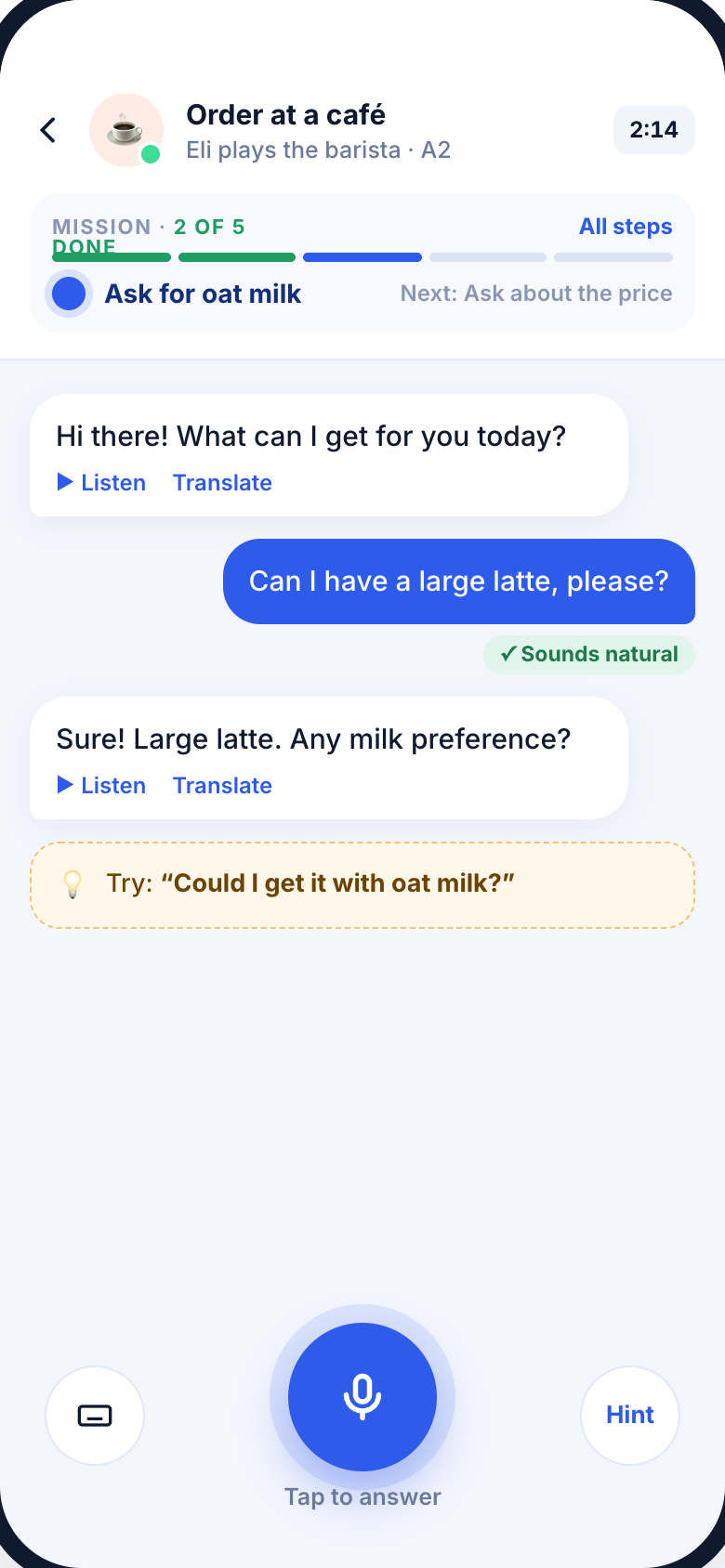
On Elispeak, you can launch an interactive DevOps Incident Simulation:
- Scenario: The AI takes the role of an Engineering VP joining an active outage call, asking: “What is the blast radius, why didn’t the circuit breaker trip, and what is our estimated time to recovery?”
- Feedback: Eli analyzes your speech for technical clarity, confidence markers, filler word frequency, and grammatical precision, with an instant retry loop to help you re-deliver your update with calm authority.
Start practicing your engineering communication today on the Elispeak app or evaluate your spoken clarity with our free AI Interview Trainer.
Frequently Asked Questions
Why is spoken English critical for DevOps and SREs?
During severe cloud outages (SEV-1/SEV-2), clear and calm verbal communication prevents duplicated engineering efforts, misdiagnosed telemetry, and panic. DevOps engineers must succinctly summarize root causes, mitigation trade-offs, and timeline estimates to both technical peers and non-technical executives.
What is the difference between war room updates and post-mortem presentations?
War room updates require concise, urgent, and factual statements focused on symptom mitigation, current blast radius, and recovery ETA. Post-mortems require analytical, blameless language focused on systemic vulnerabilities, telemetry gaps, and preventive action items.
How can I practice DevOps incident communication with Elispeak?
Elispeak provides interactive audio roleplays where the AI simulates engineering leads, product managers, or incident commanders asking for triage updates, trade-offs between failover vs. rolling restart, and root cause analyses.
Related topics
Practice
Practice this topic with Eli
Get instant feedback on your answers, pronunciation, and vocabulary.